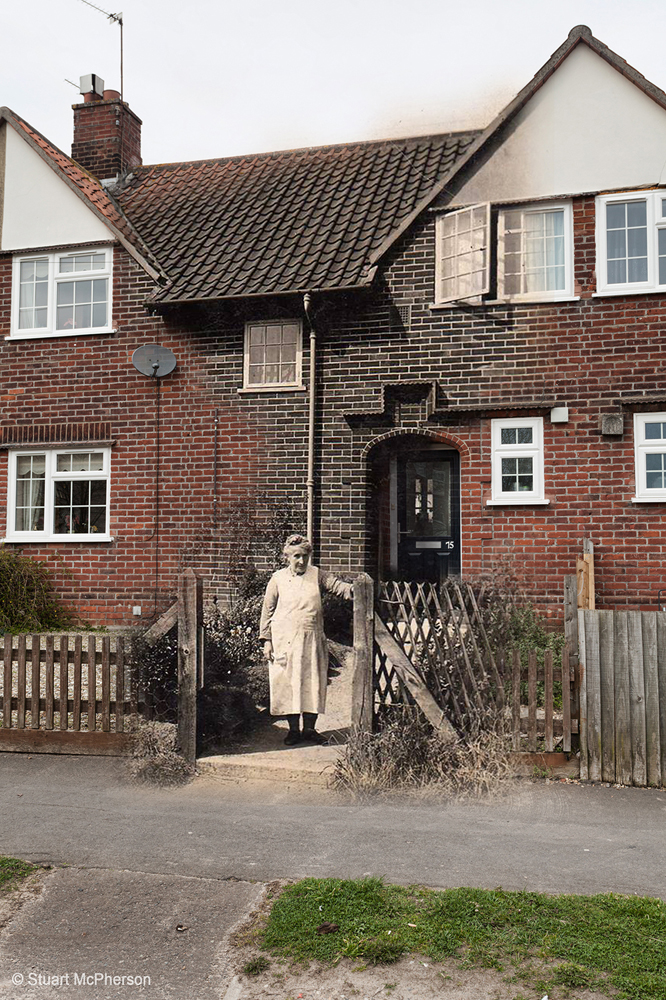
Mary Jacobs, now and then.

Reduced 75 Valpey

Just a brief entry to show that I haven’t disappeared completely. I’ve had my fingers in far too many pies of late and haven’t had time to concentrate on one thing long enough to form anything coherant enough to form one of my usual long and rambling entries.

This merging of two photographs – or ‘Ghost’ image – is of a Mary Jacobs, standing at the gate of her recently acquired Valpy Avenue home.

Back then – for reasons unknown to me – the area in which all of the houses South of Drayton Road and to the West of Havers Road were referred to as ‘The Drayton Estate’ and not Mile Cross, even though they were built by the same builders and on the same piece of purchased farmland as the rest of the estate.

It’s likely that before moving into this house Mary would have lived in one of the yards and slums around (or not too far from) the area that is now known as Anglia Square.

These new houses must have been a dream come true to former residents of the slums; they had fresh, running water; loads of space, big gardens for growing fruit and veg, indoor toilets and this particular row, a fantastic view of the Wensum Valley, complete with regular Steam engines puffing through the middle of all that scenery – a far cry from the unsanitary conditions, gloom and squalor, typical of those old and cramped yards closer to the city centre.

Mary passed away in 1938, but her family remained in this home for many years after.

Original image supplied by Mary’s Granddaughter, Susan McClarence, who informs me that her sister was born behind those very walls.

Until I can find the time to write something a little more in-depth, thanks for looking.

Stu.

Lady Jane

It was and a cold and miserable November day here in Norwich during the later stages of World War Two (November the 24th, 1944) and the clouds were hanging heavy and grey over Horsham St Faith’s Airfield. These low, heavy, lead-coloured clouds weren’t just blighting the Norwich skyline, they were stretched far across western Europe, putting a much-needed and very welcome pause to the deadly and destructive European Air War. Sitting patiently upon the airfield’s aprons of Horsham St Faiths were a collection of freshly-fuelled American B24 Liberators, waiting to be given the all-clear to head off and up into those grim and murky skies that were persistently lingering over Norfolk and out across the continent. The young American airmen crammed into these large bombers must have felt fairly relaxed, for today they wouldn’t be putting their lives in danger by heading out across the North Sea and deep into enemy airspace; instead, they were about to take advantage of this bad weather and head off up into the low-hanging clouds for some much-needed, low-visibility flight training. Continue reading “Lady Jane”

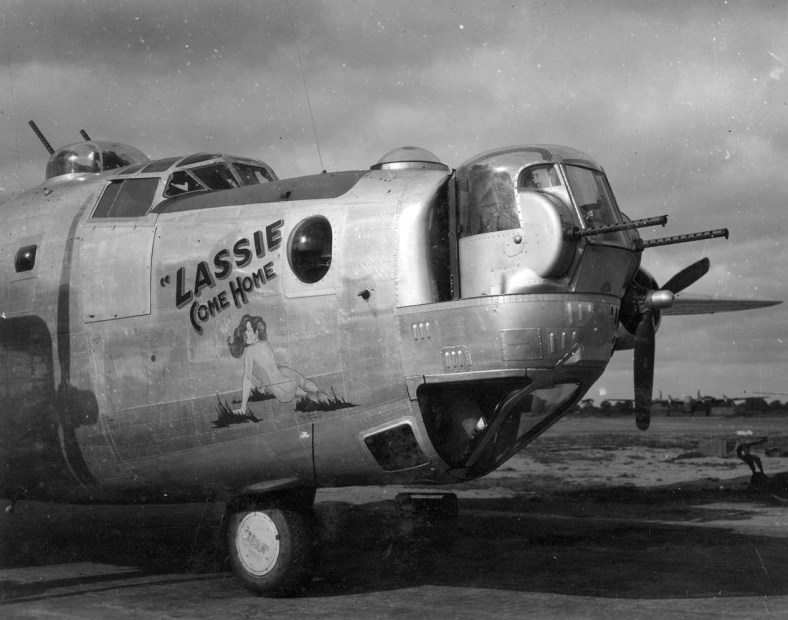
Dick’s Story: Lassie Come Home.

You may have read the last blog entry about a tragic accident that happened on the estate towards the end of the Second World War. A Consolidated B-24 Liberator of the USAAF crashed on its final approach to the Horsham St Faith Airbase killing 8 of its 9 crew, two young children and changing the lives of their friends and family forever. If you haven’t read it already, I recommend that you do so first before reading this entry and that blog entry can be found by clicking this link.

After sharing the story on Social Media I was rather taken aback by the positive response it received and it has probably been the most-read (and commented) post of this blog so far.

One of the many people who commented on Social Media was a ‘Dick Kemp’. Dick (Richard) Kemp was the young lad whose garden the plane came down onto and it was his sister and cousin who were killed along with the American Airmen. Shortly after commenting on the post Dick sent me an email asking if I’d forward him the story so that he could share it with his extended family. Of course I obliged and emailed it over. It was another one of those fantastic moments where somebody who I’ve been researching or photographing the history of has appeared to me in person, just like when David Jackson appeared at one of my exhibitions a few years ago. Whilst I had this fine Gentleman’s attention I thought I’d chance my arm and ask him if he’d mind sharing his thoughts and memories on the incident.Aircraft_DiehlWreck_LassieComeHome_FOLD3 Continue reading “Dick’s Story: Lassie Come Home.”

Lassie Come Home

AZON_Orig Lassie Come Home_WILLIAM CASEIn the northern corner of the estate and just behind the Boundary Pub is a quiet little cul-de-sac named Spynke Road. Like a lot of the roads up there it didn’t start off this way and used to share a junction with Boundary road. It has since been closed off to stop people rat-running through the estate and to reduce accidents along the now insanely busy Boundary Road. Because of these road closures the area now has a strangely quiet and closed-off feel but with the unrelenting background drone of of traffic. Continue reading “Lassie Come Home”
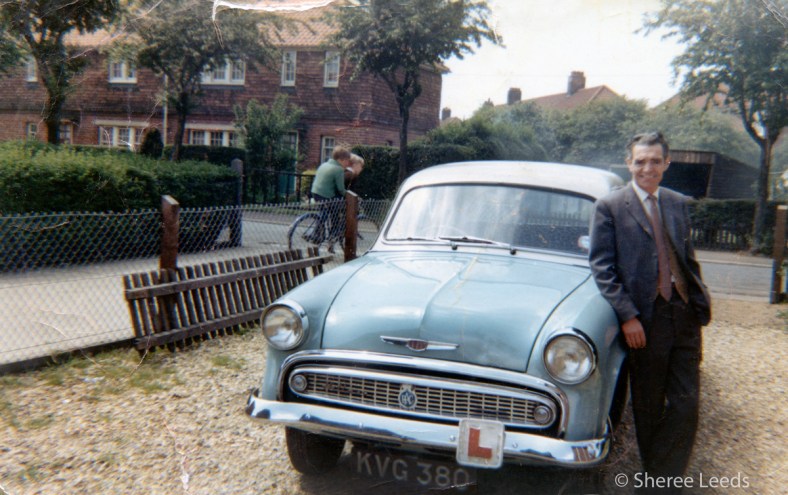
Little bits of history hiding on the shelf

In most households up and down this funny old country are lots of little hints of local history caught on film. Most people have a collection of old photographs from their or their family’s past, either sat on the bookshelf or hidden in a dusty box in that dark corner of the attic. More often than not, people often think that these little collections of windows into the past are of no real interest to strangers; after all, who wants to see that grainy photograph of Great Uncle Bob stood next to a tree? To the casual observer, that photograph of Great Uncle Bob in the 50’s is just that: a photograph of Great Uncle Bob. To somebody who doesn’t know Uncle Bob, these pictures can still reveal a lot, especially if you know where and when the picture was taken. A lot of hidden gems can be hiding in the backgrounds of some of these old photographs, especially if they were taken outside. If the shot is wide enough they can act as a handy little window into the area (and era) in which the photograph was taken. Photography wasn’t as easily accessible back then as it is today so people only tended to take pictures of things that they thought were important, mainly involving loved ones or important events. I love these old photos and am always on the look out for these taken in my sphere of interest: Norwich, Norfolk and Mile Cross.

A lady I work with has been following my blog since the beginning along with her husband, Stuart, who also happens to be an old ‘Miley’. Stuart grew up on the estate during the 50’s and 60’s. When I inquired (as I often do) into whether he had any old photos of his childhood on the estate, the response was that  there were a few but probably not of any real interest. I asked if I could see them anyway and he kindly agreed. The next day Margaret brought in a handful of tiny photographs and I went through them like an excited School kid. Did they reveal anything interesting in the background? Let’s take a look at what I found…

First up is this image of Stuart’s father taken on a bright winter’s day back in 1955:Asda junction 1955small Continue reading “Little bits of history hiding on the shelf”

Kodak Brownie 127. Sort of…

It’s been a while since my last post but that’s because I’ve had my fingers in so many little pies that I haven’t had the chance to stop long enough to concentrate on any one thing. Anyway, before my next post about Mile Cross (yes, there is one on the way) is this post about a little Kodak Brownie 127 that was given to me on New Years Eve. I was with a lovely lady named Cecilé, who was showing me around the barn at the back of her pub, The Marlpit Arms – the barn section of which will hopefully be part of a wedding venue overlooking the nearby meadow when planning is granted – anyway, I digress. As Cecilé was showing me her grand plans for the barn, I spotted an old Kodak Brownie 127 sat on a dusty window ledge that didn’t look like it had been moved for decades. Cecilé kindly let me have the old camera and I took it home with me. On closer inspection I found that – unfortunately – there was no film inside and no mystery photos from the past for me to develop. I put it on the shelf with the rest of the camera gear and decided that I would take to Google to see if I could find some 127 film to fit it.Brownie0 Continue reading “Kodak Brownie 127. Sort of…”

Nigel Neale

I must admit that I’ve talked quite a lot about Drayton Road in this blog, mainly because it has a lot of stories to tell and partly because I’ve lived on (or just off) it for all bar seven years of my life. This is the main artery for traffic in and out of the City from the North-West and effectively chops about a third of the estate off along the southern portion. Located in the Island part of the estate from the estate’s creation and up until about ten years ago sat the majority of the estate’s schools (Dowson First and Mile Cross Middle), so getting the kids across Drayton road safely required a lot of work from the two sets of dedicated Lollipop ladies.

The first set operated at the crossroads of the Drayton, Bignold and Parr Roads and the second set a few hundred meters down the road at the (long-since closed) junction of Drayton and Wheeler Road. In the early to mid 1980’s, both sets of ladies witnessed their fair share of drama and tragedy.

Two incidents stand out amongst the madness that was – and still is – getting across Drayton Road as a child and I’ll start with the later incident first:

In the mid-1980’s a driver claiming to be unsighted by the low morning sun as he came up Drayton Road from North West ploughed straight through a crowd of Mile Cross Middle and Dowson School children being shepherded across the road by the crossing lady. How nobody was killed is beyond me; one boy ended up near the bus stop, the boy walking just in front of me was thrown 20 feet into the air…. blood, chunks of hair, scattered books and Panini stickers littered the scene.

The result was this pelican crossing, installed slightly east of the junction: MXspeed3 Continue reading “Nigel Neale”

Schooled at the old skool school

Over the years there have been six schools in one form or another on the Mile Cross estate.

Dowson Infant School opened on the 6th December, 1926 and received it’s first 66 students from a small and temporary, School off Brazier Road. Then on 27th January 1928 the Dowson Primary School opened next door
, bringing in a further 193 pupils, aged 7.5 to 10.5 years. This number grew to 442 pupils by July 1934, which is quite a lot when you consider that the by today’s standards the two connected schools were fairly small.

I only have this one image of the school in my photographic arsenal and it is of one of the two School halls. It’s taken after closure, but the school can still be found on some of the older versions of Google maps. This shot is of the Mile Cross Middle School Hall. In here I used to do country-dancing (against my will), play rounders, partake in gym (in your pants if you’d forgotten your kit), rearrange the words to various hymns during assembly (can you believe we were forced to sing hymns?) and later on wear out the knees of my flecked-trousers skidding along the floor to the ‘Final Countdown’ by ‘Europe’ during many a 1980’s school disco. I always used to think it was a replica of Noah’s Ark when sat cross-legged on the hard floor listening to the Head Master, Mr Keene bang on about something or other. Looking at it now, it did look a bit boat-like.Mxmx1 Continue reading “Schooled at the old skool school”