Not long after Mile Cross had completed it’s first and second waves of house-building and providing this new housing estate with over 8,000 people, it was decided (by the Bishop of Norwich) that all of these new residents needed a bit more god in their lives. God would be shoe-horned into the new estate via the medium of a shiny, new church situated right on our doorsteps. The building of a new church is by no means a cheap venture so it was decided (once again by the bishop of Norwich) that a fundraising appeal for this new church would be sent out with haste.
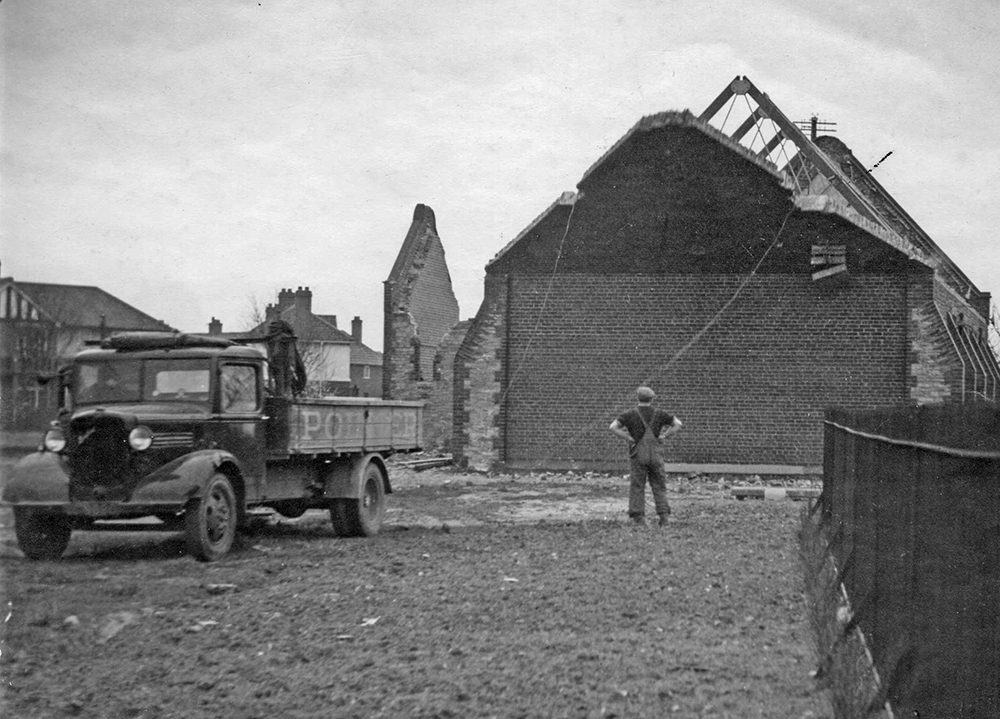
This isn’t because there was no church nearby, far from it, there was already a fairly new church (of sorts) here in Mile Cross (or Upper Hellesdon as it was known then), and it was a very Victorian affair (although it opened in around 1902/03) consisting of a neat, but fairly-plain L-shaped structure which stood in the exact same spot where the newer St Catherine’s now dominates the junction of Mile Cross Road, Aylsham Road and Woodcock Road. Having being built in around 1903 for the scattered residents of Upper Hellesdon, living in a handful of homes straddling Aylsham Road, this church could only really accommodate about 150 people if you crammed them in nice and tight, and that just wouldn’t do, especially when there were upwards of 8,000 new residents in the area. This little church was also called St Katherine’s (with a ‘K’ and not a ‘C’ for some reason) and was more of a mission hall than a traditional church, and on the early 1900’s maps it was actually listed as a mission hall, before being drawn up as a church on the later maps not long before being demolished.
The following images give us a glimpse of the scale of the structure, but sadly the only external shot showing us the whole building is of it being demolished by Pointers in the early 1930’s:
And in the photograph below we can see the rather plain-looking, but bright interior of St Katherine’s mission hall, taken at some point between 1903 and 1930:

Thankfully, for the bishop and the more religious residents, It didn’t take long to raise the money required to fund the building of the new church, as Miss Violet Wills, a member of the very wealthy Wills tobacco family coughed up all of the cash needed (pun intended). In fact, Violet had donated so much cash, that there was enough spare to also build the rather grand church hall and the very accommodating vicarage, next door. I wonder if she was feeling guilty about the way in which her family had become so wealthy and this was in some way her penance. I guess we’ll never know, smoking was still seen as good for you in the 1930’s, wasn’t it?
The Bishop of Norwich expressed his sincere thanks to Violet Wills (probably because she’d saved him a whole load of work in the process) and was quoted as saying “The wonderful munificence and kindness of Miss Violet Wills, whose liberality has made possible the new work for God in the Mile Cross area”. Well he would say it like that, wouldn’t he.
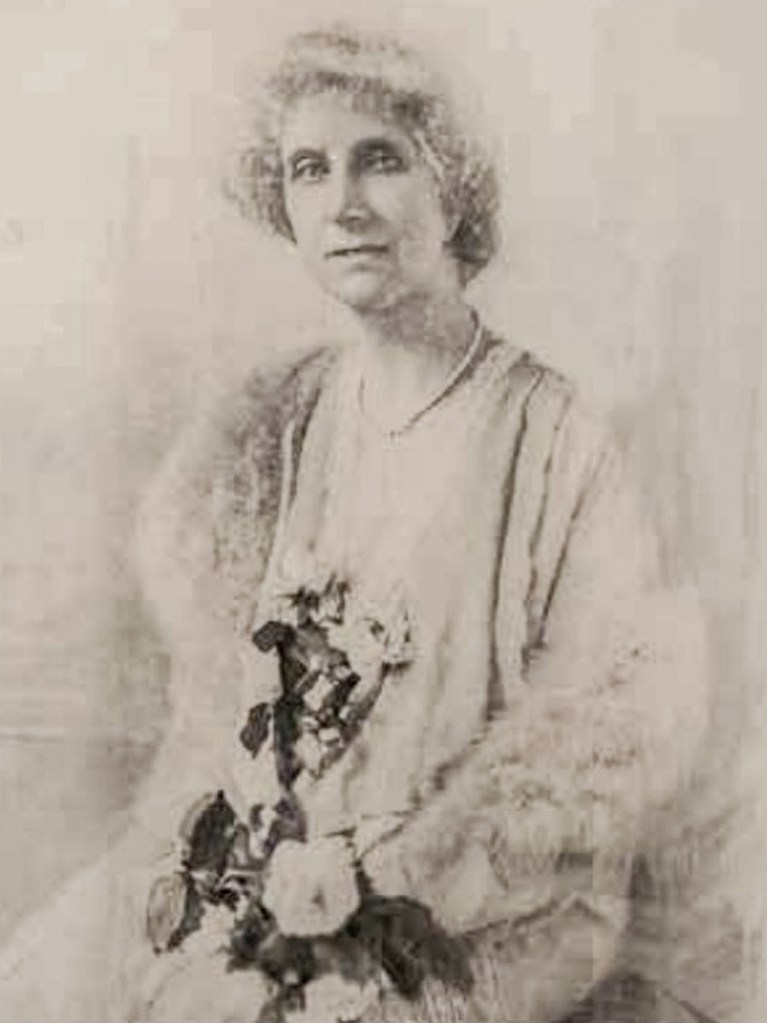
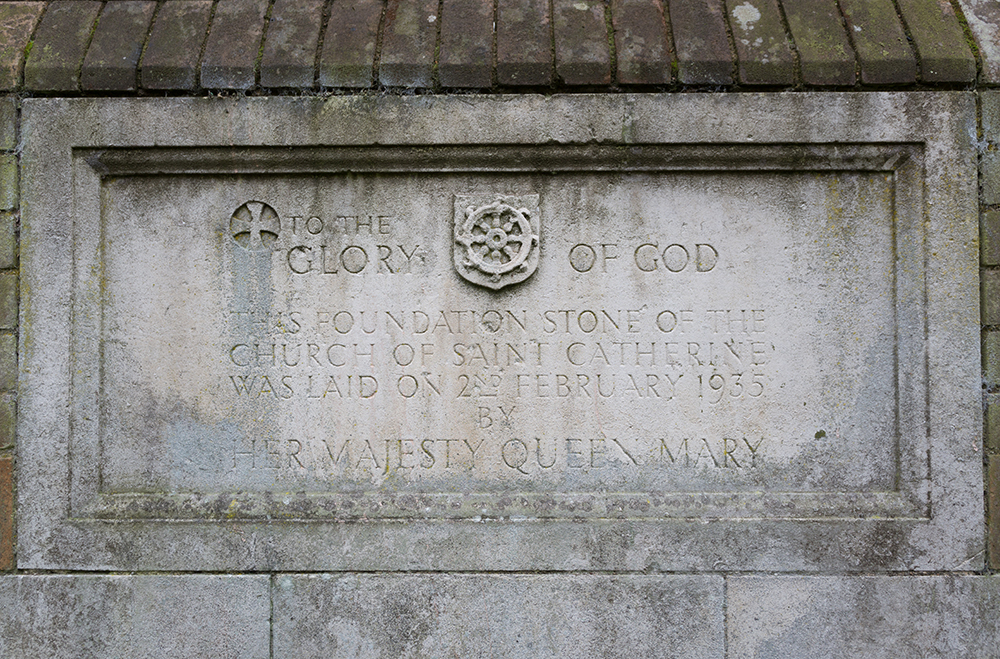
The building of this new and improved church began in the February of 1935 and it was designed by architects Caroe and Robinson. The foundation stone was laid by Queen Mary, who along with her husband King George, was a bit of a regular around these parts back the.
A large ceremony was held on the 2nd February, 1935 where Queen Mary, using a special silver and ivory trowel with an intricate Catherine wheel carved into it, also designed by the one of the architects, Alban Caroe, set the first stone in place. This rather extravagant trowel had the words “Her Majesty Queen Mary used me 2nd February, 1935” inscribed upon it. Very fancy, I wonder that particular tool is now…

About a year and a half later the church was consecrated (13th November 1936) by Bertram Pollock, Bishop of Norwich from 1910-1942 and opened to the public. It’s heavy, wooden doors were swung open to the residents of Mile Cross to while away their Sunday mornings, get themselves married or mourn the loss of their loved ones. Although no burials were ever performed here at St Catherine’s, or in any of other city’s churchyards for that matter. All city burials were stopped after 1854 as they churchyards had become ridiculously over-filled, and in some cases almost bursting at the seams. The next time you walk past a city centre church, have a look at how high the graveyards are compared to their surroundings. Thankfully for St Catherine’s this will never be an issue.

If you make your way around the northernmost edge of the church and into the shadow of the tower you can still find the foundation stone mounted into the wall and it reads: “TO THE GLORY OF GOD. THIS FOUNDATION STONE OF THE CHURCH OF SAINT CATHERINE WAS LAID ON THE 2ND FEBRUARY 1935 BY HER MAJESTY QUEEN MARY” which I recently photographed for this piece, as below:
Now I say ‘mostly finished’, and that is because this new church didn’t yet have any bells. However, this was soon to be rectified when the church tower of St Mary’s, Coslany was deemed too unsafe to carry the weight of its own bells, meaning that they hadn’t actually been swung in anger since 1908. It was decided for their own safety and that of the old church, and anybody within it, that these old bells needed a new home, somewhere they could continue to be rung in safety and so that their distinctive chimes could still be heard across the city. And where better to hang them than in the new, spacious and up until now bell-less belfry of the grand new church in the city’s grandest housing estate, Mile Cross? So in November, 1936, the same month that this bold, new church had opened it’s doors, an application was made by the Norwich Consistory Court for the bells to be sold to St Catherine’s, and in 1937 they were rehomed here in Mile Cross. What makes the rehoming of these bells even more special is that these six bells are said to be some of, if not the, oldest church bells in Norwich, having been been cast between the years 1424 and 1725, which would have made these historical bells the perfect addition to the city’s newest church.
These old bells were mounted to a massive beam within the spacious belfry of St Catherine’s, and instead of being swung, are struck by hammers controlled by ropes that can be pulled from within a little room, hidden out of site behind the western side of the nave.

If you’re lucky enough to be given the chance to ring them on one of the church’s open days, I fully recommend that you give it a try, as the sound of the oldest church bells in the city ringing out melodically across Mile Cross is a treat for anybody’s ears.
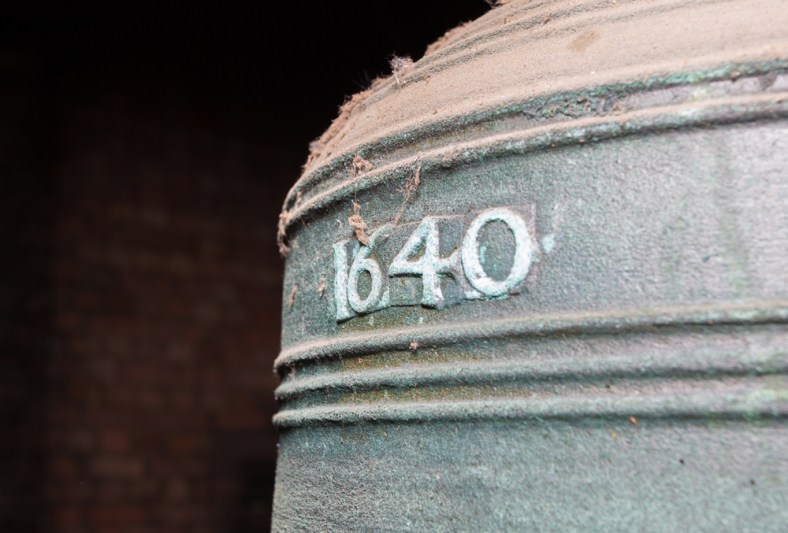
Sometimes if you ask nicely they wardens might arrange a trip up into the belfry, which is reached by a walkway going through the attic of the church, hidden out of sight, high above the nave and chancel. It’s less than grand up there, as it wasn’t really built for the public, but the bells have plenty of room to resonate their sounds out across the estate and beyond.

The only real clue to to he belfry from the outside of the church are the ten belfry louvres on the northern and southern edges of the stubby tower.

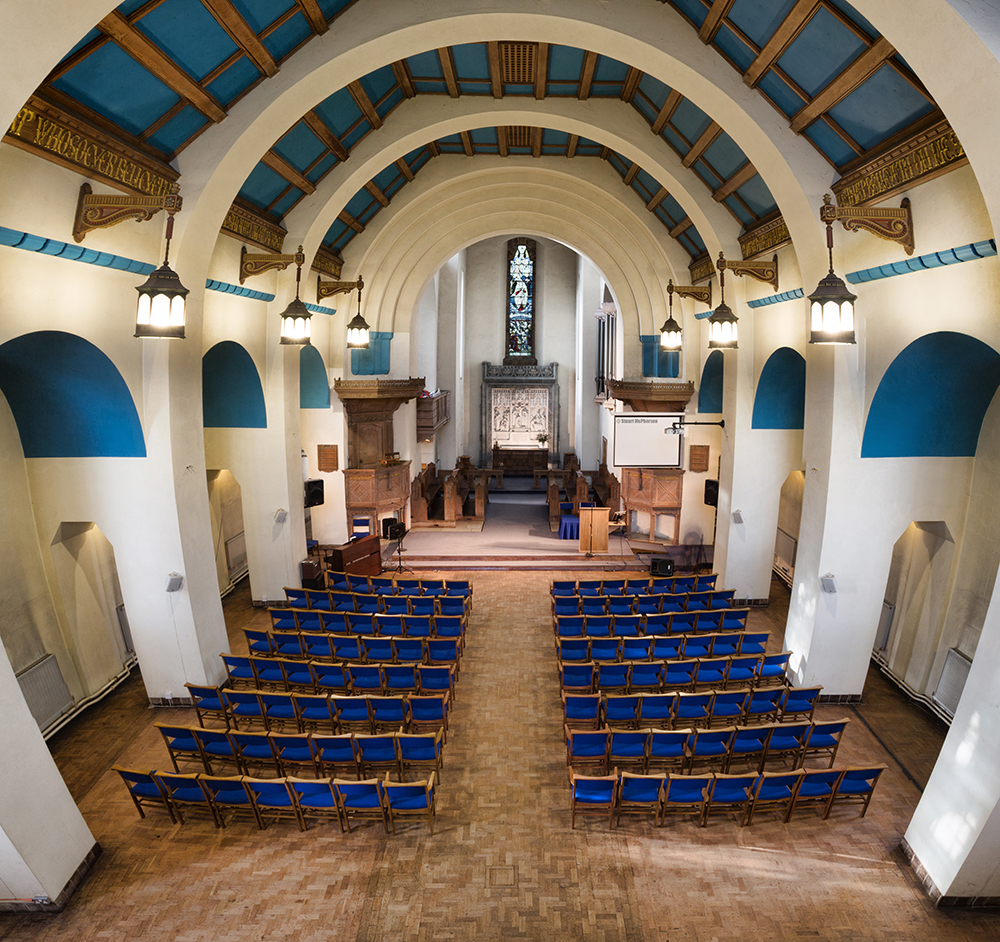
The interior of St Catherine’s is a bit more extravagant than the exterior as can be seen in the below photograph, although the strong blue colours were a later modification to the original paint job. Somebody once told me that in his later years, Alban Caroe had revisited the church that he had designed back in the 1930’s and was less than pleased with the new paint-job, which makes me chuckle whenever I enter this bold-looking church.

Paint scheme aside, The nave is nice and wide and with it’s high roof almost feels cavernous when viewed from up upon the balcony, the roof vaulting with it’s fancy hanging lanterns give the roof a strong and striking feel and the curves and contrasting angles continuing the art-deco feel of the whole church. The chancel is impressive too with it’s lofty windows and intricate reredos at the rear of the altar. Now, I’m far from a church expert and Simon Knott covers it all in greater detail on his brilliant website here: Clicky.

So there you have it, a nice little story about our very own church and its fascinating history. I’ll finish this piece with a final observation that is missed by most people, and up until recently myself, thanks to the Church Warden Sophie for educating me on this lovely little titbit of history: When the original St Katherines church/hall was demolished to make way for this grand, new church parts of the original were recycled and re-purposed for the new church, including the original church pews, of which only one survives, hidden away in the church somewhere, also if you take a look at the fantastic image below you can see that the original St Katherines was made from white/yellow stone framed with traditional bricks. These white/yellow stones were repurposed for the fence and gate posts that still mostly separate the churchyard from the rest of the estate and many of them can still be seen.
Below is a recent photograph of a long-forgotten entrance to the churchyard at Mile Cross Road and you can see the original stones from St Katherine’s hall, repurposed as gate posts.

And that’s it from me on St Catherine’s Church, for now at least. As you’re probably aware if you’ve been reading these pieces for long enough, you’ll know that I’m always scratching away at the history of our wonderful estate, and I hope you have enjoyed it as much as I have.
Thanks again for reading these pieces,
Stuart
 The Mile Cross Man
Thank you for, All I never knew about St Catherines. Growing up in Mile Cross since 1944 and moving on in the 70s I would never have guessed that I would spend Christmas eve 2024 reading up on my first parish Church, yes I enjoyed that. thanks again, Happy Christmas cheers, Rodney Matless.
LikeLiked by 1 person
I have some very happy memories of St. Catherine’s Church. When I was about 10 I played truant from School with some other pupils and we hid in the Church, I decided that I could ring the bells!! All went well until the Vicar came flying in and caught me red handed. What a stupid person and nothing has changed. Many years my baby was Christened in that same beautiful Church.
LikeLiked by 1 person
The Tower of St. Mary Coslany was about fifteen feet taller prior to the restoration of the Church in 1906. A C15 octagonal belfry housed the bells which are the subject of your article but the whole Tower had developed cracks necessitating the removal of the top stage. I recall seeing a Ladbrooke or Sillett drawing from the early C19 showing it looking much like St. Benedict’s with a flat parapet but the top part slightly corbelled out if memory serves. Such a pity it was taken down as it now makes the Tower rather too small for the Church. As a kid, I was a fairly frequent visitor to St. Catherine, Mile Cross on a Sunday afternoon, after having met up for lunch with some of the family who lived nearby on the estate. I think Caroë’s Church is a memorable building- an elegant round-arched take on ES Prior’s St. Andrew’s, Roker. Both churches deservedly feature in the Thames and Hudson book on Edwardian Architecture.
LikeLiked by 1 person