As a young child who grew up on the estate during the 1980’s, there were quite a few familiar elderly Mile Cross residents whose friendly faces I’d regularly see as we made our way about. Quite a few of those gentle faces are etched into my memory, and now, when I’m wandering around the estate as a middle-aged man, on my way to the pub with my dad, popping to the shops, or simply out for a walk, usually wondering where all that time has gone, I’ll pass a particular house or spot and a memory will suddenly be triggered.
I love these little moments. They’re always unexpected and normally always a pleasure, and for a brief moment I’ll be dragged back to those hazy, rose-tinted days of innocent youth. Every now and then I’ll find myself wondering about those faces from the past and what there stories were.
What I hadn’t thought too much about as a child, when encountering these people, was that many of those elderly residents had most likely lived here since these homes were built in the 1920’s. They had probably seen a lot during their lives, growing up in a very different Norwich to the one I’d grown up in, and they must have watched Mile Cross, and the wider world, change around them.
One thing I’ve noticed over the years of researching the estate is that, until relatively recently, people around here didn’t move about very much. Families often stayed in the same home for decades, sometimes for many generations, which meant that many of these elderly residents had been here from the very beginning.
I have very vague memories of an elderly man tending to his front garden as we made our way noisily past on our way to school. I don’t remember much about him, but I do remember his face and the cheeky smile he’d give us as we made our past.
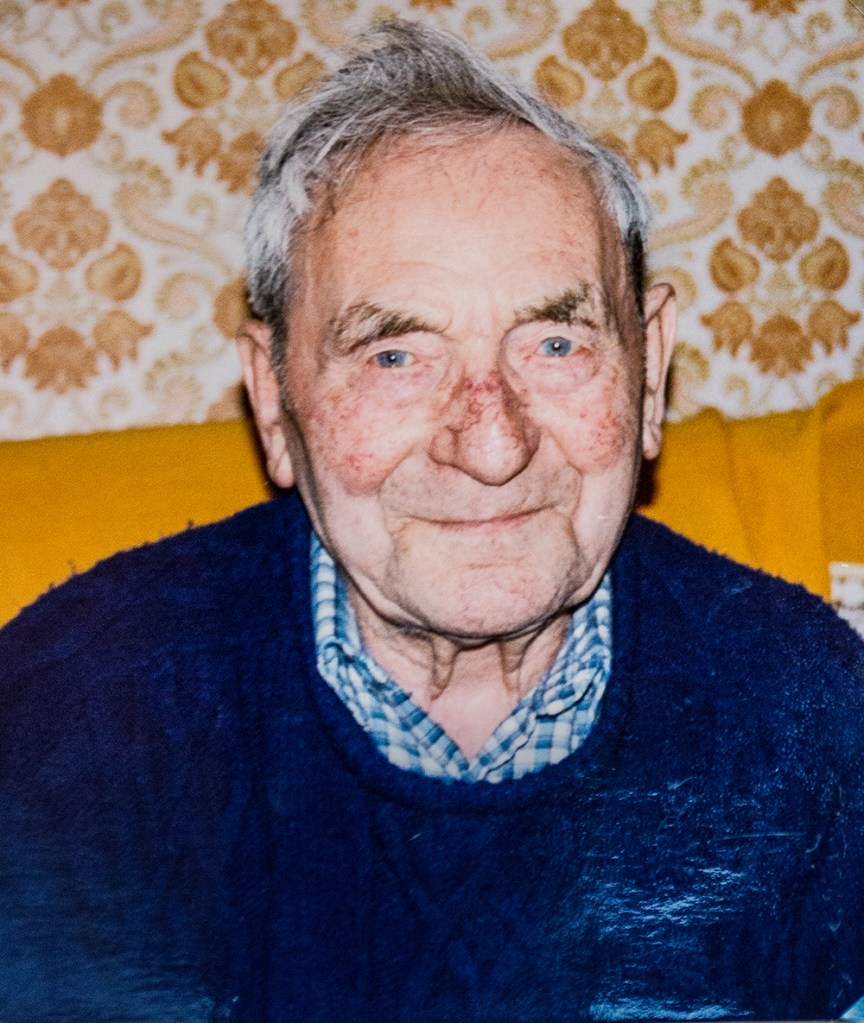
I later found out during the research phase of the ‘Mile Cross 100’ project that this particular friendly-faced old gentleman was Charlie George.
As a young man, Charlie was one of the hundreds of men employed after the First World War to build the new homes here on the Mile Cross Estate. He was as a bricklayer, who I think, rather wonderfully, eventually ended up living in one of the houses he helped to set out. A house that he would spend living in, not for a few years, but for the rest of his long and eventful life.
Charlie was born in 1904, while his parents lived in in an old cottage out at old Bowthorpe. Back then this area was the remnants of a lost medieval village surrounded by fields, rather than the 1970’s and 1980’s housing estate we know it as today.
The growing George family then moved a bit closer to the city and into one of the last of the Victorian-style terraced houses that are so prevalent throughout Heigham and Lower Hellesdon, however these last few old-style terraces were built in the early 1900’s, the very last of the old style of narrow terraces. The new George family home was located at the bottom end of Nelson Street, close to Heigham Street and Dial House and it was here that Charlie grew up.
He would eventually follow in the footsteps of his father, William George , who was also a skilled bricklayer, and had helped to build some impressive structures here in Norwich. Among other things, William had worked on the city’s Victorian sewer system and the impressively long wall that runs along Waterworks Road, which can still be admired today.
William had rather more stories to tell than your average bricklayer, too.
He had volunteered to join the Army during the First World War, having come to the realisation that conscription was coming. He opted to stay one foot ahead of the game, and to have some say in where his destiny was about to lead him. Rather than being forced into becoming an infantryman, he chose to become an engineer and was involved in the installation of barbed wire around the trenches. Not that this kept him out of trouble. On one occasion he was gassed, but thankfully survived the war and somehow returned home to Norwich, unlike many of his peers.
Charlie recalled once that his father coming back on leave in 1917 and sitting in a chair crying. Charlie had never seen a grown man cry before, and this was something that would stick with Charlie for the rest of his life. It was something that stuck with his father, too. William George was very vocal in his opposition to war, and in particular, to Nuclear Weapons, too, and he became an ardent supporter of CND.
William was also a card-carrying trade unionist from the 1920’s, a Labour campaigner and fundraiser, and was also involved in rising money for the Republicans during the Spanish Civil War. He was also a member of the Amalgamated Union of Building Trade Workers, and his political will and interests clearly rubbed off on his son, although not straight away. Charlie had a scratch that needed to be itched.
As a young lad Charlie was often given the task of having to row across the nearby River Wensum in a flat bottomed boat to pick up milk from the Gowing Farm, situated on the other side of the river and across the Midland and Great Northern Railway line.
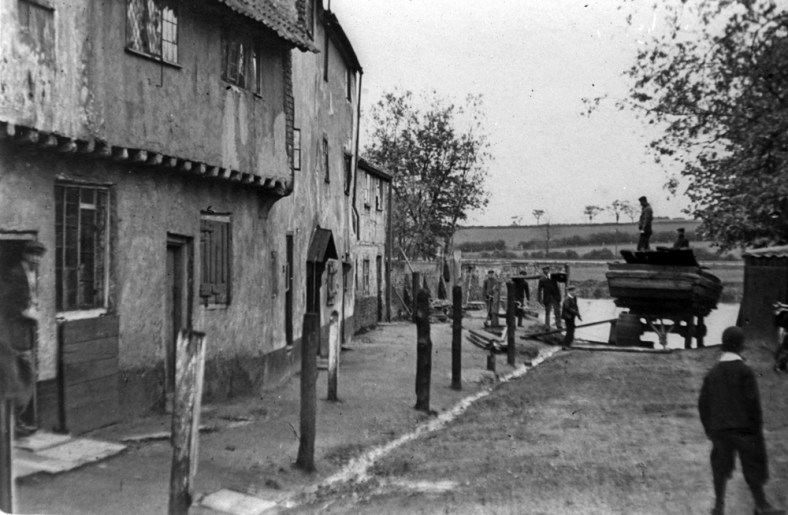
This old farm stood close to where Havers Road now meets Mile Cross Road, and eventually gave Old Farm Lane its name. Mile Cross Road and its bridges across the Wensum, and the Railway Line, wouldn’t be built for almost another two decades.
Dolphin Foot Bridge was built in 1909, but it would have been much quicker for a young George to just take the more direct route (about 300m) straight across the river and then over the railway line via one of the farm’s cattle crossings at what we now know as Anderson’s meadow. Back then the area was a low-laying grazing area next to the Wensum, forming part of the old farm. I imagine that young Charlie would have sailed across at the end of Heigham Watering, a former ford and a regularly used crossing point over the Wensum for centuries. Little did he know then, as a boy punting across the river to collect milk from a fairly secluded farm, that in the future he would be instrumental in changing this rural scene completely, as the expanding city began swallowing up the farm, and most of its surroundings.
After the First World War, Charlie managed to land himself an apprenticeship with Norwich City Council as a bricklayer, but as a young man who had seen his the generations before his lead a rather more eventful life, he craved a little more adventure. It was time to scratch that itch.
The young Charlie quickly grew bored with learning to lay bricks and decided to run away from home, abandoning his newly acquired apprenticeship in the process.
He joined the army instead, ending up in the Cavalry in Dublin with 15th King’s Hussars in 1919. His mother was less than impressed with his escapades, having no idea where he had disappeared to. According to the family story, she refused to lock the doors for three weeks in the vain hope that he’d eventually return home one evening with his tail between his legs.
Once a young Charlie had gotten all of that excitement out of his system, he returned to Norwich and re-joined the council, finishing his apprenticeship. He eventually gaining full-time employment and working under his father, who was also his foreman.
As ever in Charlie’s young life, this stability was to be short-lived.
Work for bricklayers in Norwich had slowed down so much that William had to make the hard decision to lay off his own son, giving him one day’s notice. His reasoning was that his son was young and single while the other men had wives and children to feed. Back then, a whole days notice was seen as very reasonable!
Charlie took being made redundant gracefully and decided to move to London for a couple of years in pursuit of employment.
Eventually he returned to Norwich to marry his childhood sweetheart, who had lived in a house on Heigham Street on the Waterworks Road side. Their back gardens had backed when Charlie lived at Nelson Street and it seemed like destiny had intended them to end up together all along.
By now it was the early 1920’s and the plans for the much-needed Mile Cross Housing Estate were beginning to take shape. The massive building project was to provide opportunities for men, like Charlie, who really needed the work and to provide opportunities for out of work soldiers to learn new skills, particularly focussing on the many men struggling to find work after The First World War. The ‘homes fit for heroes’ were about to be be built by the heroes themselves.
Charlie was to be one of those men.
By 1924 he and his new wife were living in one of the first homes to be built in Mile Cross, up at Bolingbroke Road which was one of the quickly-erected Dorlonco homes, that were tucked away behind the grand ‘Architects Houses’, while Charlie was working as a bricklayer for Evans of Old Catton, one of the local contractors involved in the construction of the rapidly expanding estate.
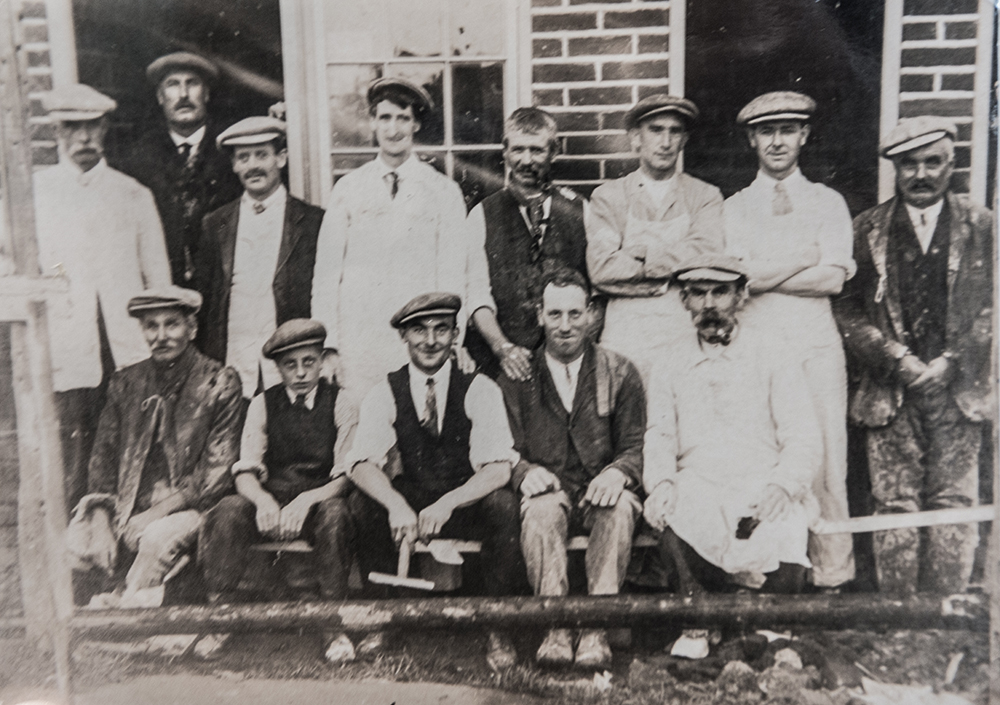
This is where Charlie’s story takes a wonderful twist.
Charlie eventually given the opportunity to chose one of the newer, larger homes. He chose one of the houses that he had to ‘set out’ himself at Drayton Road. This home was to become his forever home. He’d handled the bricks, mixed the mortar and watched those walls rise out of the fields of Hellesdon, gain a roof and windows and become a home. His home. Imagine building your own home with your own hands, No wonder he had such a strong connection with it.
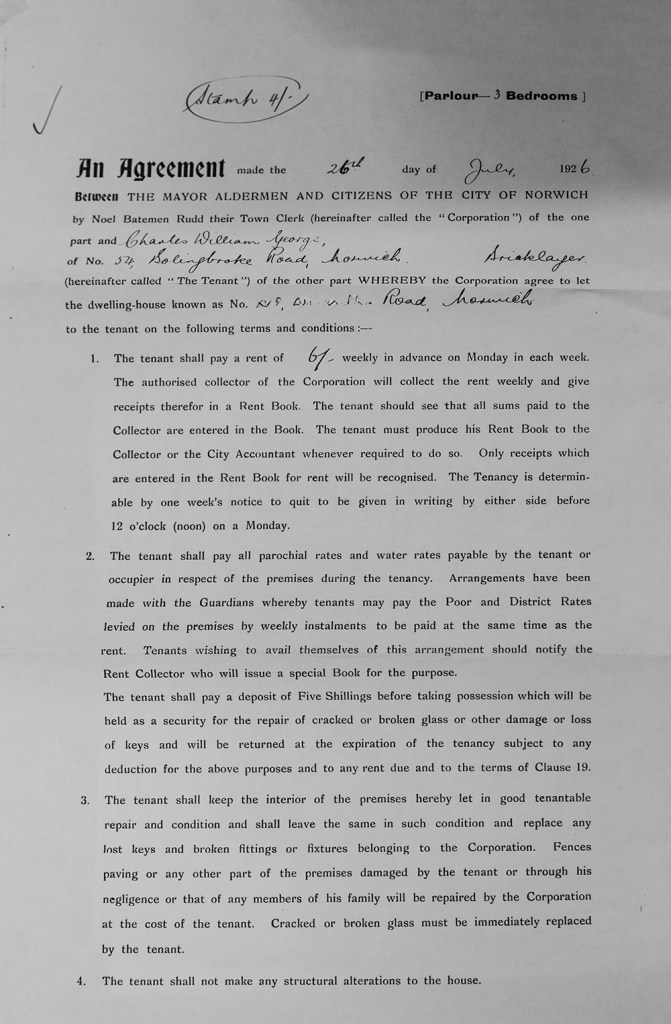
His new house was located on the southern side of Drayton Road (known as The Drayton Estate back then) and not too far away from the Parade of shops that were still being built at the time. Charlie was given a choice of homes here and opted for middle house, as he believed it would be easier and cheaper to keep warm. Practical. Charlie and his family moved in to their new home on the 26th July, 1926 a whole century ago and his rent was 6 shillings a week.
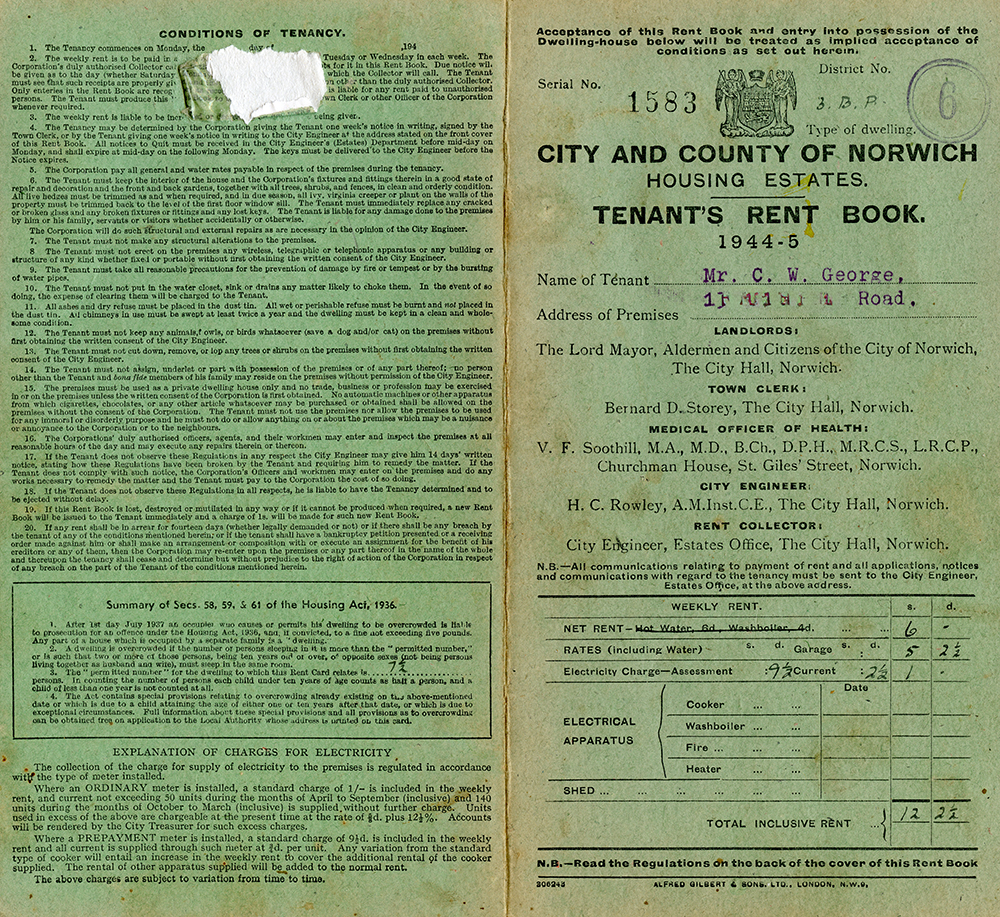
I don’t have a copy of the original rent book, but I do have a later copy from 1944/45, but by this time the rent, including rates and electricity, had increased to 12s and 2.5d, which according to an internet search engine equates to about £35in today’s money. It seems quite cheap, but it only factors in the value of money, not the costs of living, which have increased exponentially.
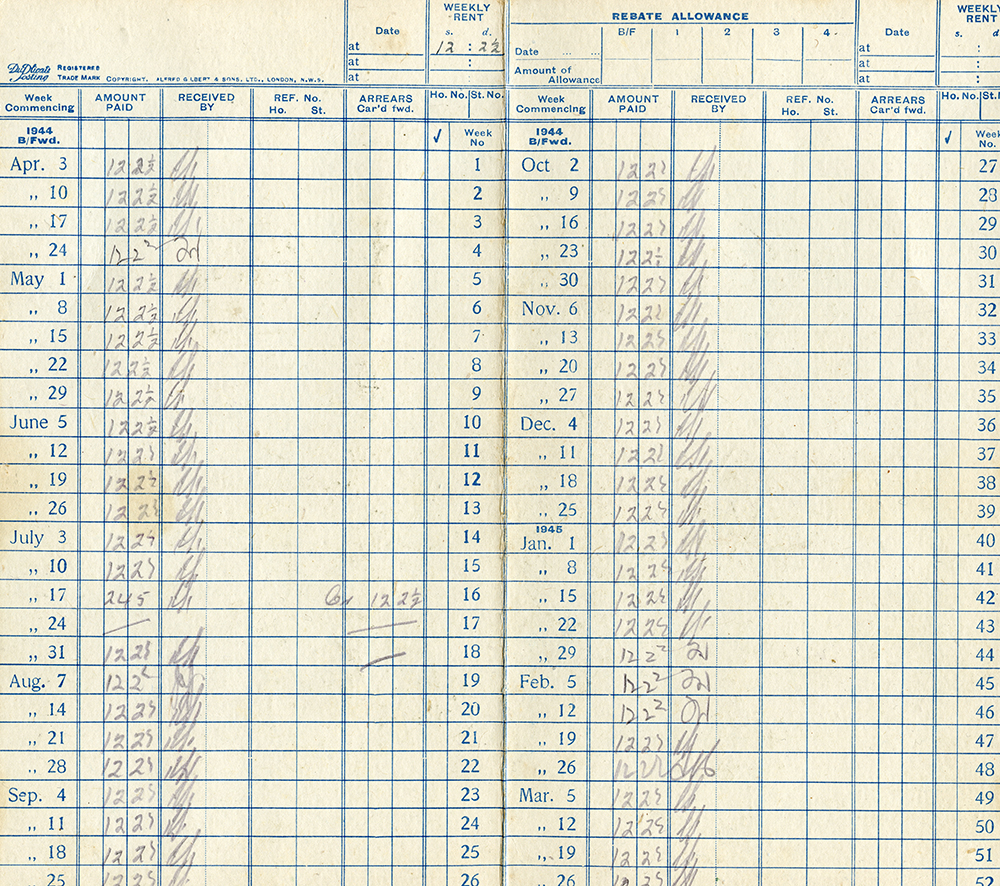
A hundred years later, Charlie’s Rental agreement feels special, it marks the point where his relationship with Mile Cross changed for good. He was no longer just a builder, helping to construct the new estate, he was now a resident of Mile Cross. He was home, and he was to stay here for the rest of his life.
Charlie often used to reminisce about those early days and he’d tell the younger members of his family how lovely the new estate looked when he moved in to his new home, mentioning that the fresh verges were made up of lush, green grass. The coalmen and milkmen would allow their horses to graze on the verges and that Mr Peruzzi the Ice Cream Man would purposefully bring his horses to Drayton Road just to graze. An idyllic and peaceful scene that seems impossible to comprehend a century later due to the increasing use of cars, which has pretty much destroyed those once-lush verges and many of those once lovely green front gardens.
Idyllic as it must have been back then Mile Cross and its residents were about to be put to the test, firstly by The Great Depression, which had arrived in Britain in the early 1930’s, bringing mass unemployment, falling wages and hardship to millions. Britain had already been struggling economically after the First World War and, as a major trading nation, was badly affected by the collapse in global trade. As if that wasn’t bad enough, the clouds of war were bubbling up over Europe once again.
Norwich didn’t escape it, Mile Cross didn’t escape it, and neither did Charlie.
He eventually left his work with the council and, in 1931, began working for Morgan’s Brewery as a maintenance man. Charlie stated that these were the most enjoyable years of his working life. That said, Charlie and the manager of the brewery didn’t always see eye to eye, particularly when it came to trade union matters, but they seemed to have developed a mutual respect for one another, despite their political differences.
Charlie recalled one particularly good example of this when he was on his way to the station, headed for a trade union meeting in London, when he happened to bump into the manager of the Brewery, who bought him first class tickets and then gave him a lift home from Thorpe Station in his chauffer-driven car.
Not bad treatment for a “troublesome trade unionist”, and it shows the level of respect he’d earned.
Charlie had eight relatively peaceful years working at the brewery, until in 1939, when war broke out once again. Charlie was tasked with building the brewery’s air-raid shelters, and at the same time he also signed up for the Mile Cross Auxiliary Fire Service, which had set up a new station in the former Dairy, situated in the remnants of the old farm nearby at Havers Road. The same farm, where as a boy, he’d crossed the river to collect milk. The war had somehow brought his life full circle. Over the years of writing these articles, I’ve noticed that these stories have a habit of doing that.
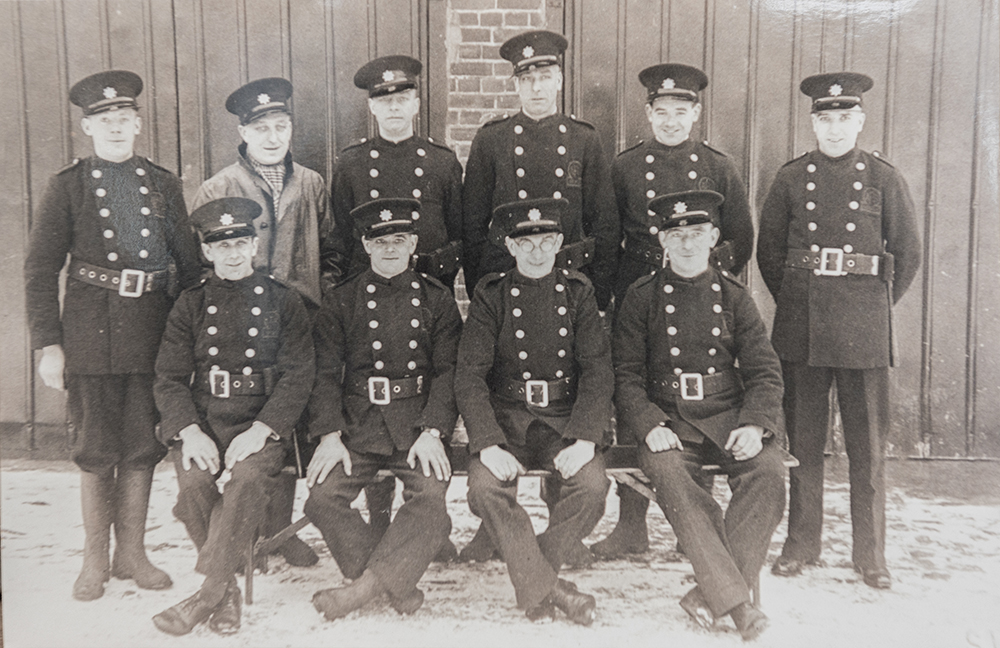
During the infamous 1942 Baedecker raids on Norwich, Charlie was at home on Drayton Road when the air raid sirens began to ring out across the city.
He quickly rushed his family to the air raid shelter, located at the end of their garden before running down the road to house a few doors away, where one of the bedrooms was on fire. Thankfully the family were tucked up safely in their own shelter, but this didn’t stop Charlie from rushing into their home to extinguish the fire by throwing the burning bed linen out of the window. He could now hear the distinctive sound of falling bombs and decided that it would now be a good time to seek shelter himself and ran back home to join his family in the relatively safety of his own air raid shelter.
This turned out to be a wise move, as not long after he entered the shelter, a high explosive bomb landed in the middle of Drayton Road, blowing off most of his roof, shattering all of the windows and blowing out the walls of the toilet. Luckily Charlie and his family were unharmed, having been safely tucked away in their shelter. Had he been a few moments later returning from helping his neighbours, it could have been a completely different story. Charlie wasn’t finished though, and as soon as the dust had began to settle he dashed off out again to see if anybody needed help along Drayton Road. What he found was a massive crater in the road and being rapidly turned into an impromptu pond due to a ruptured water mains. Shortly after, ambulances arrived to help with any casualties and Charlie decided to make his way back to his Fire Service Unit at Havers Road to see if he could help with the carnage that was still raining down on the city from above.
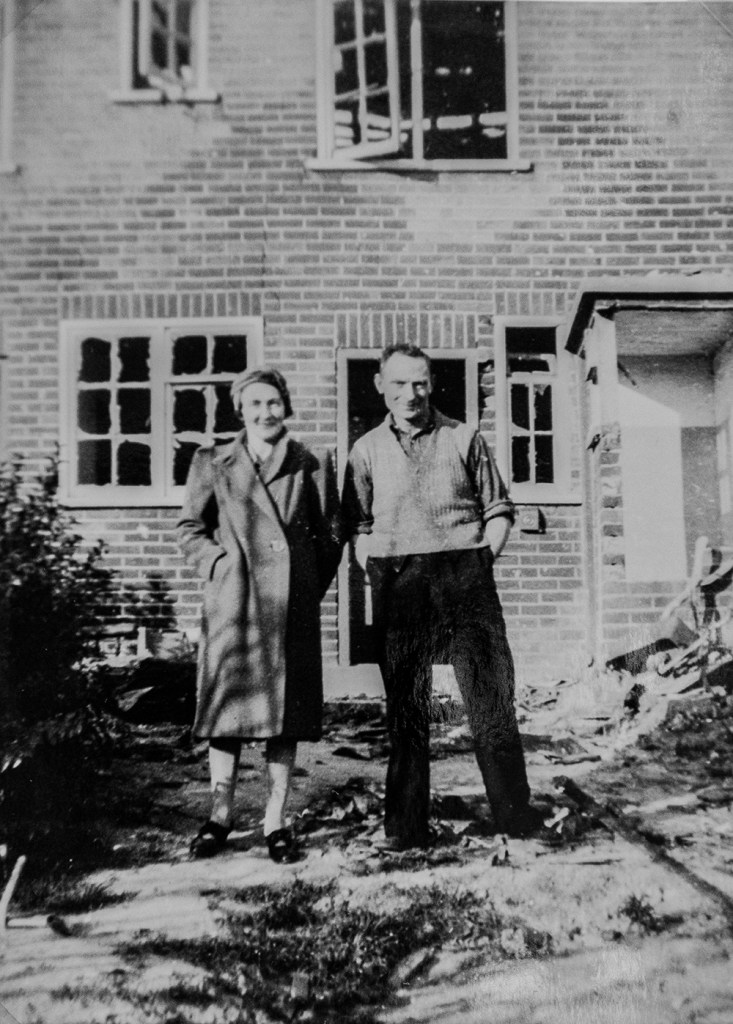
Of course, when he got back from his fire service duties he then set about helping to rebuild his home himself. And let’s be honest, who else was more qualified to do it than Charlie?
The War hadn’t finished with Charlie yet, and more excitement was heading his way. If only he’d known all this when as a younger man when he’d run away from his home life in pursuit of it. He needn’t have bothered. It was coming for him now, and at an unrelenting pace.
During another bombing raid on the city, the Colman’s site had been targeted, and of course, Charlie was on the scene to help out. When he returned home the family noticed that he had been completely stained yellow due to mustard dust that had been released during the attack.
On another evening, Charlie and his team had been sent to help with a fire raging at Bonds Department Store, but when they arrived on the scene it was clear to all that it was too far gone, and that there was nothing that could be done to save it. Whilst there, Charlie noticed that his place of work, Morgan’s Brewery, was also on fire. Knowing that all of his tools were there, he rushed down to King Street immediately to see if he could save them. He managed to rescue the tools, but the rest of the brewery was in a dire state, fires breaking out everywhere. Sadly the hops were all ablaze and were creating a six foot deep froth, that had covered the brewery floor and was streaming out into the street. Next up Charlie decided to save his managers car, an expensive Riley 12 which was locked up in a garage which was about to catch fire, which probably helped his relationship with his boss. Not content with all that danger, Charlie then went on to rescue all of the horses from the Morgan’s Brewery stables, leading them to safety down Bracondale.
He was also in the vicinity of St Julian’s Church when it’s circular tower was mostly destroyed. It seems as though Charlie was never really that far from the action!
After the war had passed and peace had returned to the city, Charlie went on to become a full-time trade union organiser, remaining with the same union he’d joined earlier in his life. His patch covered much of East Anglia, and for this he was eventually given a car for his work, with the added bonus that it could also be used for leisure purposes. This must have been quite the perk back then, when cars were still seen as a bit of a luxury, however, it’s obvious that he’d definitely earned it.
On one occasion he had to drive out to the Power Station at Great Yarmouth on trade union duties where he had to climb to the top of the chimney to talk to somebody who was on strike up there, which was probably not in his job description, but Charlie never seemed to shy away from a challenge. Even after the war, he was never far from a little bit of excitement!
Politics were now a core part of Charlie’s personality and he was proud to tell people that he had voted in every single election he possibly could, and political discussions were a regular feature at the family dinner table. He was renowned for being a political pragmatist and had a very keen interest in local politics, almost becoming a councillor himself, only being stopped by not being able to get enough time of work to do it. You needed a sympathetic boss back then if you wanted to become a local politician, and although there was an obvious respect for Charlie at Morgan’s, I’m guessing they didn’t want him becoming too influential.
Charlie was also keen to continue to self-educate, like many men of his era he’d left school at the age of just14, he had an appetite to learn and spent a lot of his spare time taking educational courses and reading historical, political and legal correspondence.
There was another twist in Charlie’s relationship with the house he’d spent most of his house living in as a traditional Labour man and trade unionist. He made the hard decision to buy it under the Tory ‘Right to buy’ scheme, which must have presented Charlie with a massive moral dilemma. His reasoning being that people were being led to believe that local authority rents were set to rise considerably, making it harder for the working classes to stay living in the life-long homes, and of course he wanted to protect the house that he’d built for his family.
Even his father got behind the idea, telling him: “You’d be a fool not, to, Charlie”. So he did. The home now belonged to Charlie. Charlie was now part of the house, and the house was now part of Charlie. Not that anything had really changed: He’d built it, defended it, repaired it, loved it, paid for it many times over by faithfully paying its rent over the decades, and after all, these houses were only supposed to last for 60 years. His house will last a LOT longer than that.
In his later years Charlie had become a director of a co-operative, continuing his involvement in politics, trade unionism and of course his local community, Mile Cross. Of course he did. He genuinely cared for the place where he’d built his home for life and he cared for the wellbeing of others around him despite any political differences, and I think we could all learn something from him, particularly during the volatile political landscape we inhabit now. We all need to be a bit more Charlie.
I often say that these stories have a habit of coming round in circles. Charlie sent his daughters to the Dowson School and he had attended the CNS until he was 14. These are the very same schools that I attended. I also grew up on the same road only 400m away, my parents buying their council home, which was a moral dilemma my wife and I also had to wrestle with when we decided to buy our council home for fear of rents becoming means-tested by a previous government. Thankfully, that never happened, but we weren’t prepared to take the risk. This home is now my responsibility, and I probably love it almost as much as Charlie loved his own. There’s also the possibility that Charlie had helped to build this house, too, and I love that idea.
By the time I came along in the 1980’s, Charlie was simply one of those familiar faces to me, but it turns out he was so much more than that, he was part of the landscape, part of Mile Cross, part of his home. Charlie is a brick ion the history of Mile Cross, which in itself is in important part of the history of the fine city that we are lucky enough to inhabit.
This is why I love researching Mile Cross, you never know what you’ll learn, but it’s almost always fascinating, always lovely and always going round in brilliant circles. We walk past these houses every day, but we rarely stop to think about the people who built them, or the people who lived in them.
We might just see bricks, windows, front gardens and familiar roads, but these houses and streets are brim-full of stories. Some just waiting to be told. There’s so much extraordinary hiding in amongst in the ordinary. I absolutely adore that.
When I was a kid, some of the people who lived next door, or just around the corner had arrived here when Mile Cross when it was little more than a building site, some even before that, and they watched the roads being laid, the houses being completed and the open spaces and verges turning lush and green. They watched the estate fill with families, children and shops. They also lived through depressions, wars, rationing, strikes and the constant changing dynamic of Norwich as a whole. Their generations witnessed massive change in a relatively short period of time.
Charlie was one of those people, and he watched it all happen out of the windows of his Drayton Road home, and this is why this story will really stick with me.
When I walk past his home now, I see it differently. It’s not just another Mile Cross House; it’s the house that Charlie built, it’s the house that he chose, it’s the home that he brought his young family to, it’s the house that the Nazis tried to take from him and failed, it’s the house that Charlie put back together with love, and it’s the house where I’d spot Charlie tending to his garden and not give him a second glance as I made my way past, probably noisily, on the way to school.
I don’t remember much about him, but I do remember his face. And now thanks to a bit of digging and a head full of curiosity, I know the story behind that gentle-looking face and infectious smile. He wasn’t just an old chap pottering about in his front garden, he was one of the men that built Mile Cross, dragging the city’s housing stock kicking and screaming into the next century at a time when Norwich needed that the most, he was a trade union man that cared for his colleagues, he was a survivor of a war that came to his doorstep, a volunteer fireman, a hero, a well-loved dad and grandad, and an inspiration to his relatives, he was everything that is good about Mile Cross.
Charlie lived in this house for the rest of his life, until he passed away in 1999 at the princely age of 95. What a life.
His house still belongs to his family, and long may that continue.
Thanks for reading,
Stu

